

The transition to a circular bioeconomy
Plant-reinforced functional composite materials
Biobased products and materials are central to the transition towards a circular economy and to meet the objectives of the European Union green deal to reach a climate-neutral Europe by 2050. The COMPOVERT project contributes to this ambition by developing functionalised composite materials reinforced with plant-based fibres or particles, via the valorisation of local (by)-products such as lignocellulosic fibres or lignin.
Many players in the plastic and biocomposites value chain are active in the cross-border region between France, Wallonia and Flanders, including agricultural producers (e.g. flax or hemp fibres, wood), composite manufacturers, and end-users in various sectors such as transport, building, sport, consumer goods, medtech or agri-food. COMPOVERT will provide solutions and support to these local stakeholders towards plastics with a lower environmental footprint.
An integrated transborder approach is essential to meet the needs of these companies, by bringing together complementary skills, and technical resources and fostering collaboration between well renowned specialists in biomass and plastic processing.
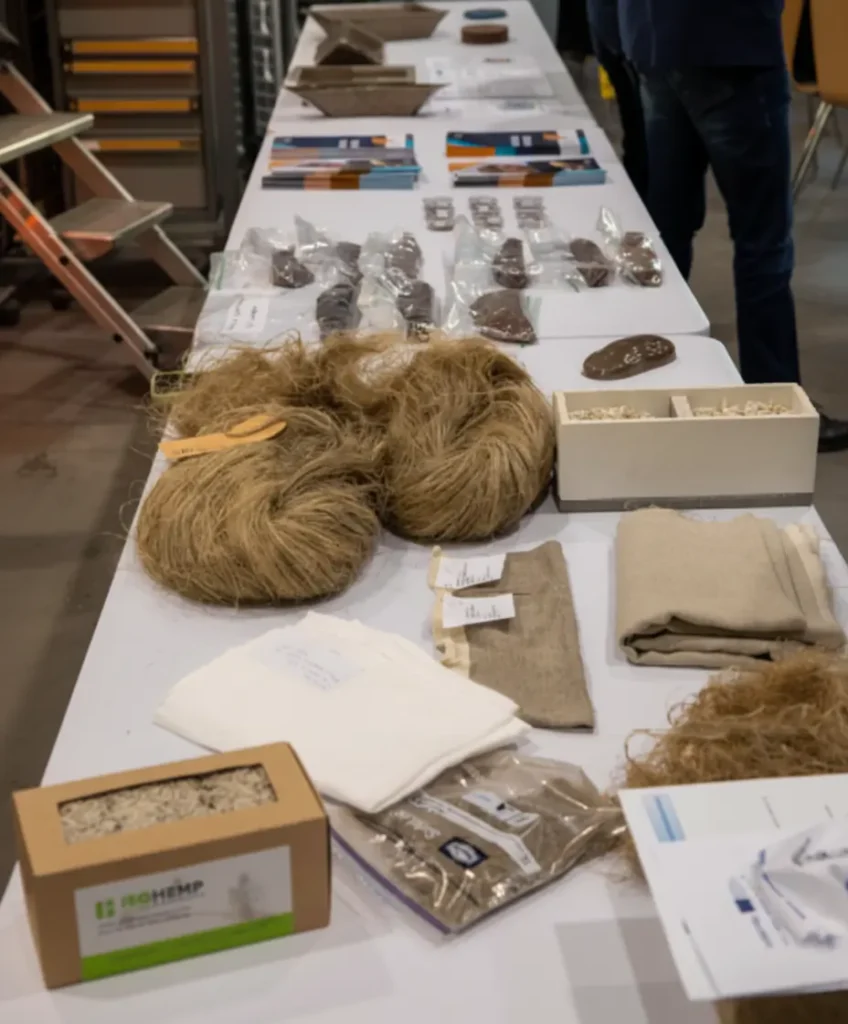
Building on previous development as well as on its deep knowledge of the application markets, the COMPOVERT team focuses its applied research in two main axes, namely on the development of the materials themselves (polymer matrices, lignocellulosic reinforcement, plant-based particles) and on the design and process of multifunctional biocomposites. One of the project’s objectives is to achieve substantial gains in both the productivity and the quality of the fibres and lignin to be isolated for biocomposite applications. It will be achieved by introducing AI at the core of the selection and process of the plant-based inputs. COMPOVERT will therefore provide solutions to get starting biobased materials in line with the specs required by industry as well as a range of lignins with improved antistatic, antibacterial or antioxidant properties. Recyclability is also a very important concern and thermoplastic matrices will be favoured. In addition to local natural fibres, such as flax or hemp, different local (by-)products are to be used for the processing of the biocomposites. These include lignin, starch and lignocellulosic fibres of varying sizes, ranging from cellulose nanowhiskers to continuous fibres.
Compovert for high-performance biocomposite products that are more ethical, sustainable and local
To meet growing demand
These technologies are robust, well-controlled and accessible across the different partner organisations. However, some specific tuning is still necessary to achieve the objectives of the project. Co-injection and co-extrusion will be applied to tailor the surface properties of lignin-based composites. Additive manufacturing will be used to obtain composites containing cellulose nanowhiskers (CNW) starting from gels containing CNW and polymers.
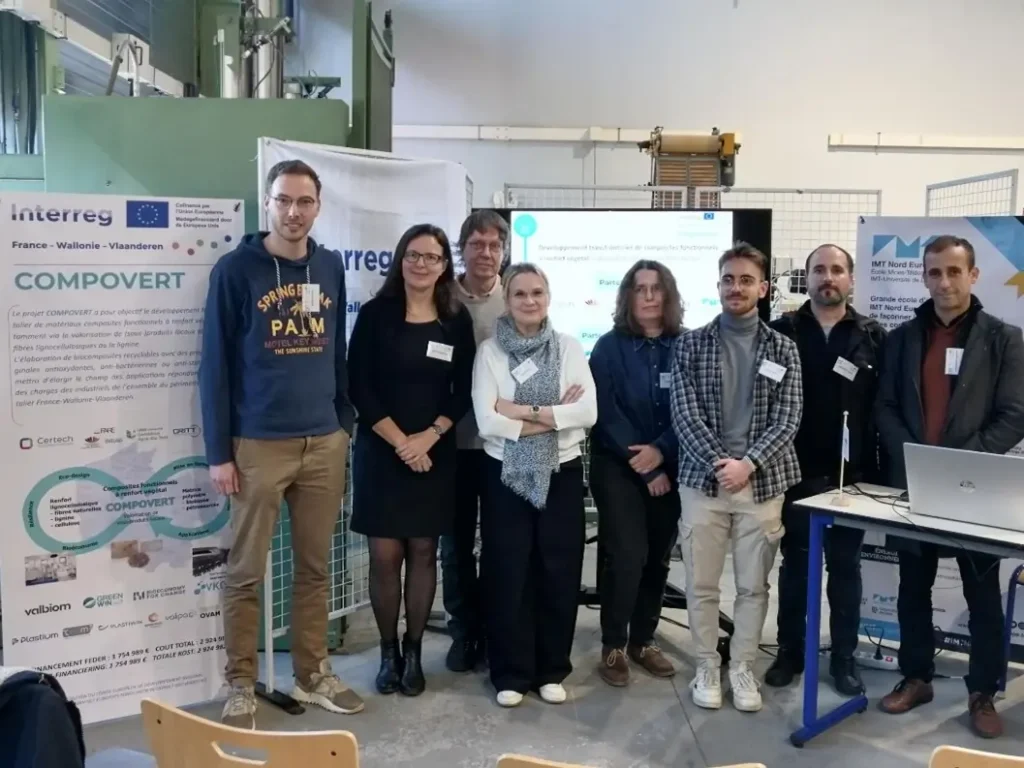
The trans-border approach of COMPOVERT relies on many human and technological resources from five well established partners (Certech, Université de Reims Champagne-Ardenne UMR FARE, Université de Liège Gembloux Agro-Bio Tech, CRITT Matériaux Innovation and IMT Nord Europe) that combine their expertise to meet to the growing demand of more efficient, ethical, locally sourced, and environmentally friendly biocomposites. Their efforts are further supported by four associated partners, namely Bioeconomy For Change, Valbiom, Greenwin and Centexbel.


Total budget
2,93 millions €

ERDF budget
1,76 millions €

Duration
48 months