


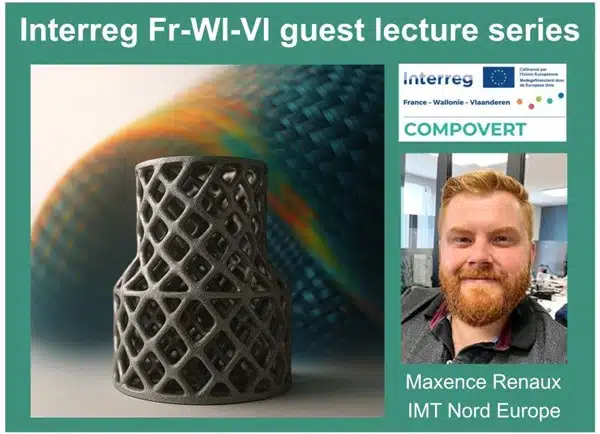
As part of the OBIWAN Interreg Guest Lecture Series on 28 April 2026, COMPOVERT will present a detailed analysis of the driving role played by additive manufacturing in the evolution of R&D practices. Initially considered as a rapid prototyping tool, this technology is now establishing itself as a fully-fledged production solution, capable of overcoming the geometric limitations of conventional manufacturing to meet the precision needs of modern laboratories. By enabling a direct transition from digital design to the physical object, these processes offer unprecedented flexibility in managing technical iterations.
The presentation provides an overview of the various technologies available as well as their fundamental principles, before detailing their concrete impact on experimental agility. The focus is on how the design of technical components and specific tooling — such as those developed within the Interreg AGILITY project — enables the optimisation of scientific instrumentation. Whether it involves creating complex experimental setups or the one-off production of advanced structures such as metal-printed catalytic reactors, additive manufacturing transforms manufacturing constraints into opportunities for innovation.
Finally, there will be a discussion on the sustainable development prospects in line with the COMPOVERT project. The integration of new polymer matrices reinforced with natural fibres, whether short or continuous, is an important area of research. This convergence between 3D printing and biocomposites is a key driver for producing components with optimised mechanical properties whilst reducing the environmental footprint of these devices of tomorrow.
This seminar will be held online; registration is free but compulsory here.